Tern · project
Sonar
The line's gone, or you got close but 15ft visibility doesn't make close the same as close enough. This is meant to tell you which way to swing.
Concept An idea in preliminary design; it should be possible, but isn't done yet.
What it is
A direction-finder for the last stretch
Sometimes the line is down, or you can get close to a wreck but can’t quite find
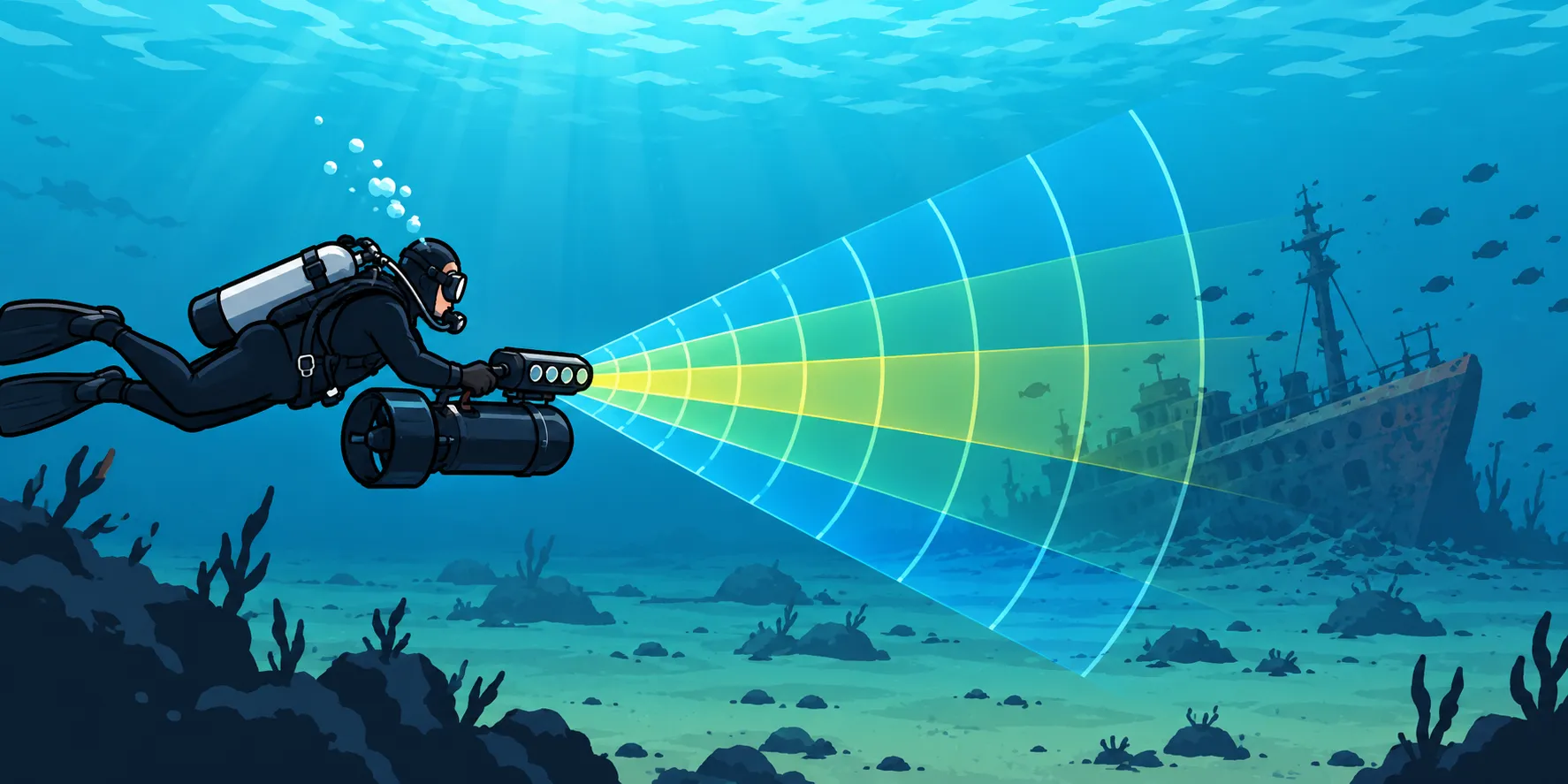
it. The idea is simple: mount it on the front of the scooter, hold it level, and swing
slowly through a circle. With five transducers, you get some indication as the array
swings onto a target, confirmation as it sweeps through the next one, and a highlight
when you’re pointed straight at it — enough to say “generally this
direction.”
What it isn’t
Not mapping-grade sonar
Military and professional packages can pick out submillimeter detail hundreds of
meters out. This will not be that. You can't do that in this price range. You can't come close.
The transducers under consideration have a
15–20° beam width, so this is a coarse pointer, not a bearing fix —
and right now it’s earlier than that: the board is ordered, not assembled, and
nothing has been tested in water yet. I've done quite a bit of ultrasonic work, so I'm confident I can build something that works. The question will be whether it works well enough to make it a practical tool for actual divers.
Where this stands
Proof of concept, staged in phases.
The array is the whole point, but it’s not where this starts. Phase 1 proves the
electronics on one channel before any cost or complexity goes into five of them.
Phase 1 — single channel
One TUSS4470 front end driving one 235 kHz piezo disc, on an Adafruit Feather
ESP32 V2. The question this phase answers: can the electronics generate a clean
burst, read a believable echo envelope, and tell a real bottom return from air and
noise? Firmware is written; waiting on board and parts to arrive.
Phase 3 — the array
Five elements, a shared low-cost driver, and a 12–24V pack in a 3″ Blue
Robotics housing. This is the actual concept — direction from sequential returns
across a sweep — and it only gets built once Phase 1 proves the single-channel
chain works. One huge challenge will be building a modular array of transducers that actually holds out water, and isn't radically complicated, and can be built by a hobbyist.
Nothing here is new to me, but the water is. I’ve done ultrasonic
work before and have a handle on how the signal chain should behave —.
But confidence isn’t data, and until the first housing is wet-outside-dry-inside and providing useful data, every number on this page is a design target, not a measurement.
Specs
What’s designed so far.
Phase 1 hardware and firmware, plus the Phase 3 target this is all in service of.
Front end, transducer, processing, interfaces, and the planned array. | Front end | TI TUSS4470 ultrasonic AFE — burst generation, H-bridge drive, bandpass filter and echo-envelope capture in one chip. |
| Transducer (Phase 1) | STEMINC SMD25T85F234S, a single 235 kHz piezo disc — a known part, chosen to validate the electronics before committing to an array. |
| Processing | Adafruit Feather ESP32 V2. Generates the burst on the RMT peripheral at 12.5 ns resolution and samples the echo envelope on an onboard ADC. |
| Interfaces | A serial CLI and a web UI at sonar.local share one ping engine and return identical JSON; the web side adds a live chart, auto-ping and CSV download. |
| Range axis | Switches speed-of-sound between air (343 m/s) and water (1480 m/s). Near-range numbers currently read slightly short — burst start time is taken in firmware rather than triggered off the real first pulse — until it’s calibrated against a known distance. |
| Planned array (Phase 3) | Five elements in a 3″ Blue Robotics housing, a low-cost shared driver, and a 12–24V battery pack. Target cost is under $1000 per unit, possibly as low as $500. |
Roadmap
Where this is going.
Directional, not promised — more than most Tern projects, since none of it is tested
yet. The further right, the more likely it changes.
Now
Actively being built or tested
- Bring-up firmware is written: web UI and serial CLI on one shared ping engine, raw TUSS4470 register access, live chart and CSV export
- The Rev A schematic — TUSS4470 plus Feather ESP32 V2 plus the single 235 kHz piezo disc — is reviewed and the board is ordered
Next
Committed, not started
- Assemble the ordered Rev A board and work through the bring-up sequence: bare Feather, then TUSS fitted with no transducer, then a scope on the burst outputs, then the transducer in air, then a bucket of water
- A first real ranging test against a known target, and calibrating the burst-timing offset against it
Later
Directional, may change
- The actual concept: five transducers in an array, held level and swept slowly through a circle, giving escalating returns and then a confirming highlight as the scooter points at a target
- A low-cost 5-channel driver and a 3″ Blue Robotics housing, aiming for comfortably under $1000 per unit
- A dual-ESP32 split — timing/processing and display/guidance — once a single channel is understood, mirroring DPV-Nav’s NAV/DISPLAY architecture
Open problem. Whether a 15–20° beam width across five elements gives useful left/right/centre discrimination once it’s actually in the water. Nothing has gotten wet yet, so this is a bet backed by prior ultrasonic experience, not a measured result.
Source & docs
Build one.
The source isn't public yet. It opens when Sonar is far enough along that you could genuinely copy the
work — a repository you can't build from is just a pile of files. What it's waiting
on: something worth publishing — this one is early enough that there is no repo yet.
Licensing
How you may use it.
Undesignated
Source-available, not OSI-open: free for divers and tinkerers, not for commercial
resale. The full position — including the labour-for-a-friend carve-out and the
Tern trademark note — is still being written up.
A pointer, not a reason to leave the line.
Nothing about this project is validated yet — not the range accuracy, not the
beam-width discrimination, none of it. Even once it is: a coarse direction indicator is
not a reason to abandon standard lost-line or lost-diver procedures, and it is not a
substitute for training, a reel, or your own judgement.
This is a hobbyist, DIY instrument with no warranty and no certification of any kind.
Read the full safety position →